For Property Managers
Multi-site scheduling, one point of contact, and documentation that survives a change of manager.
You inherit buildings whose underground history is a line item. "Drain cleaned", a date, an invoice number. Nothing about what the line is made of, where the defect was, how far down the run it sat, or whether what was cleared was a blockage or a symptom of something structural. Then the same building backs up again and you are making a judgement call with no evidence in front of an owner who wants a recommendation and a figure.
The recurring invoice is usually the tell. Where roots are the problem, jetting treats the symptom. They grow back, and the joint they are entering through is still open. A line that gets cleaned on a schedule is not being maintained — it is an untreated defect on a payment plan, and every year it stays undiagnosed is a year of spend that bought nothing you can point at. A camera survey turns that into something an owner can actually decide about: here is the pipe, here is the defect, here is what it costs to keep doing this versus fixing it once.
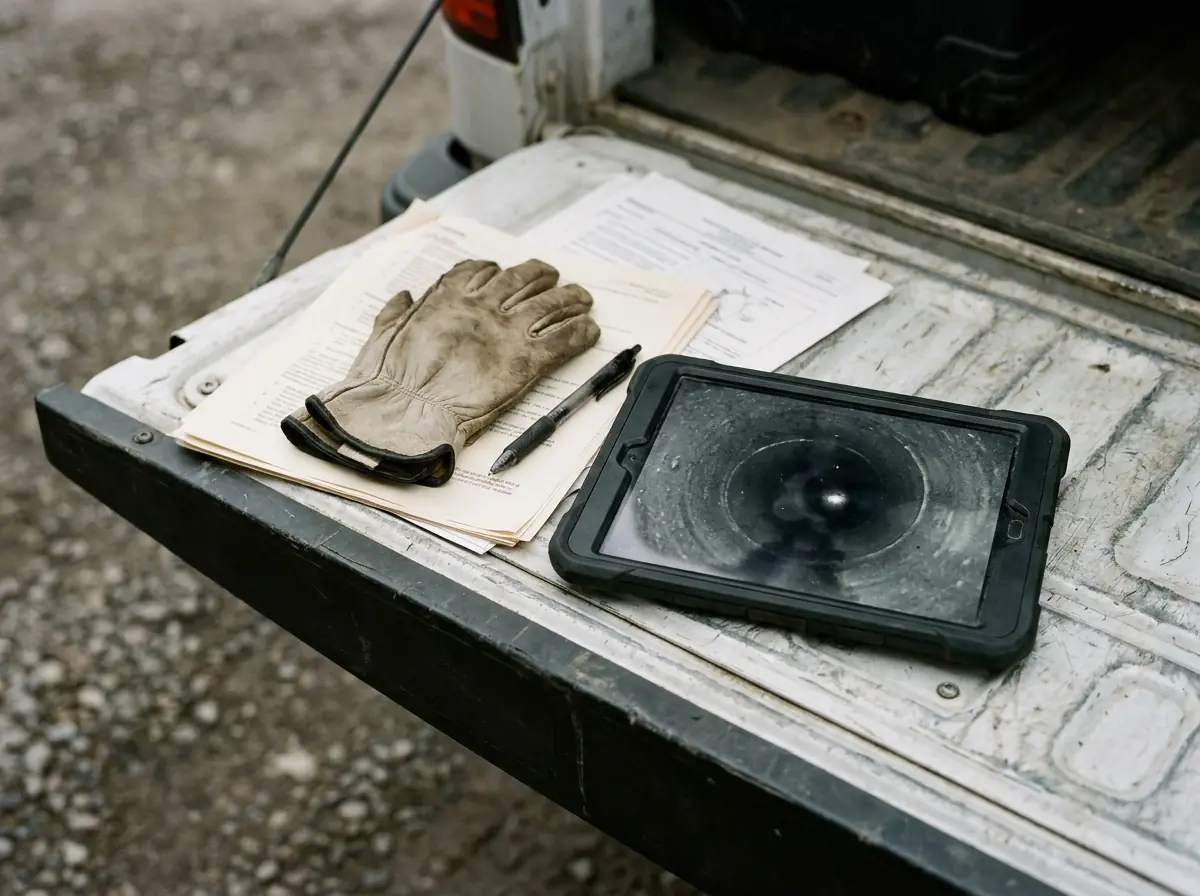
The other half of the problem is continuity. Managers change, buildings change hands, and the person who understood why a decision was made is frequently gone by the time it matters. So the deliverable on every job is footage and a written report, in your hands and in your records, readable by somebody who was never on site. A service ticket that says "cleared" is not a record. It is a receipt.
What the day actually looks like
We do not survey portfolios. Surveying every building you manage would be a large invoice for information most of those buildings do not need, and we would rather say that than sell it. The buildings worth looking at are the ones producing calls, then the ones whose line runs under the most expensive surface, then everything else at whatever pace suits your capital planning. What comes back per building is short: what the line is made of, whether there is a defect and where, what method the pipe will accept, and — often — that it needs nothing at all this year.
Day to day it runs on one point of contact and one number. Sewage in a suite at two in the morning is dispatch, not a ticket, and a human answers around the clock. Scheduled work is different: locates have to be cleared before anything goes in the ground, so underground work cannot be booked at the same notice as a leaking faucet, and we will tell you the realistic date rather than the one you want to hear. Tenant notice periods are yours to set and we work to them.
What decides the scope
Per building it comes down to the length of the run, the depth, the material, how much of the line is under pavement, and whether there is an accessible cleanout at all — where there is not, gaining access is its own small job before any of the rest can start. Age of the stock does most of the predicting. On anything built since plastic became standard the survey is usually short and the news is usually good: Long clean runs. A defect in PVC is usually one identifiable event at one location, not a line-wide condition.
Across a portfolio the drivers are different ones. What proportion of each site is paved, whether a line crosses a shared easement or leaves the title entirely, and what occupancy window each building will bear. Scope is the other variable and it is not always up to us: It fixes one place. A line with defects at six joints does not want six patches — at some point the full-length answer is both cheaper and better. A single located defect in sound pipe is a small, quick job. Six bad joints in the same run is a different conversation, and pretending otherwise at quote stage only moves the bad news later.
What people get wrong about this
Annual cleaning booked as maintenance
One clearing is an event. Three in three years on the same line is a diagnosis nobody has made yet. The cost of a camera survey is small against what three years of repeat callouts has already cost, and it is the only way the recurring charge ever stops.
Jetting a line nobody has looked down
It cannot be used safely on a pipe that is already failing structurally. Jetting a badly deteriorated line can finish it. On older stock that is a real risk, not a theoretical one, and it is why we camera before we clean rather than after. A contractor who arrives with a jetter and no camera is not in a position to know which line they are dealing with.
Accepting a report you cannot hand on
Footage that lives on a contractor's portal is footage you lose when the relationship ends, and a report written for the contractor's file is not written for yours. Ask for the recording in a format you can keep and store it with the building, not with the vendor. You will need it at turnover, at sale, and the next time someone proposes a full replacement.
Assuming the line stops at the property line
A run frequently continues past the boundary before it reaches the main, and who is responsible for which section is not something a contractor should assert. Confirm with the City who owns the section that failed before anyone quotes the whole length — it changes the scope and sometimes it changes who is paying.
When this is the wrong answer
If your portfolio is mostly newer stock, you may not need a trenchless specialist in any standing arrangement, and we would rather tell you that than set one up. A building on long clean plastic with one blockage a year needs a drain cleaner and a properly placed cleanout, and that is the entire recommendation. If your goal is to reduce the number of vendors you manage, we are the wrong move — we are one trade, buried sewer and water plus the drains that feed them, so we are an addition to your list rather than a consolidation of it. And if what you actually need is high-volume drain cleaning across thirty buildings on a contract, a larger drain company with more trucks will serve that better than a specialist will; our value is in the buildings where the answer is not obvious, and it is wasted on the ones where it is.
Questions about property managers
The ones that come up on this work specifically. The general questions are answered on the FAQ page.
Can you deal with tenants and occupants directly?
What do you need from us to quote a property?
What about a line that keeps blocking in the same place?
People also ask
Answered in full, once, on the page each one belongs to — rather than repeated on every page of this site.
Nothing is quoted off a description
The camera goes down first and you keep the footage. If the answer is that there is nothing wrong with your line, that is what you will be told.