Water Line Replacement Cost
What drives the price of replacing a water service — length of the run, depth, what is on the surface, and what the old line is made of.
There are no figures on this page. Not a range, not a per-foot number, not a "starting from". That is a deliberate position and the reason is specific to this trade: a number published without the four things that actually set it is not information, it is an anchor, and the reader who carries it into a conversation with three contractors is worse off than the reader who carries nothing. What this page does instead is tell you exactly which questions decide the number, so that you can tell which of three quotes has been thought about.
The larger point is that a water quote and a sewer quote are not built the same way, and people compare them as though they were. On the sewer side this company will tell you it cameras the line before it quotes it, and that is not marketing — it is how the number gets settled. The camera shows the material, the defects, their positions and whether the line can be lined, and the quote follows from what is on the screen.
None of that is available on a water service. Not a camera job — water services are too small. Leaks are found by acoustic detection, pressure test and correlation, not by looking down the pipe. So a water quote is assembled from indirect evidence: what the pipe is made of where it enters the building, the age of the construction, how the meter behaves with the house shut off, where the acoustic work puts the problem, and — where it genuinely matters — what a single exploratory hole shows. A contractor who quotes a water service replacement without establishing those has not priced your job, they have priced an average one.
What the day actually looks like
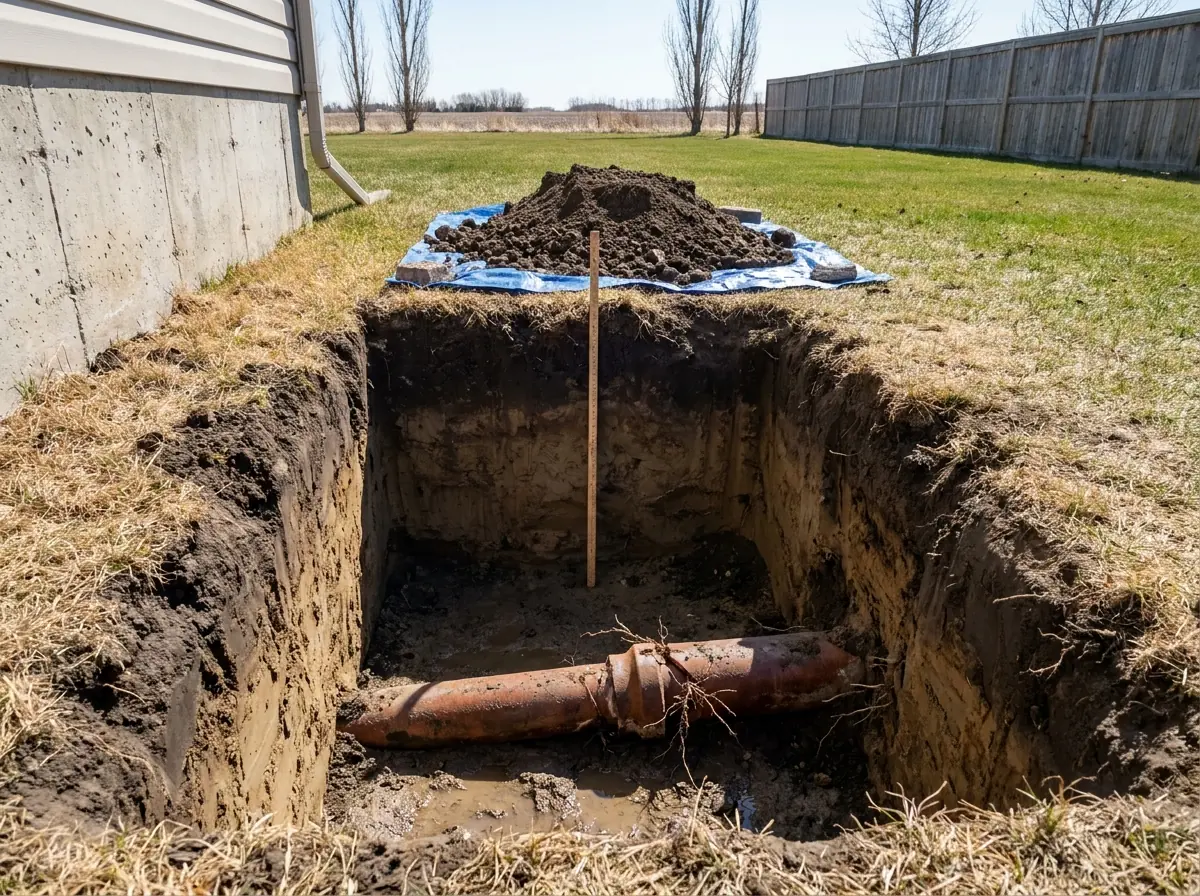
A quote worth comparing has four quantities behind it and you can ask for all of them. How long the run is from the connection to the house. How deep it sits. What the existing service is made of. And what is on the surface between the two ends, item by item — sod, driveway, walk, boulevard, trees, retaining structures, irrigation. Every one of those is a reinstatement line, and reinstatement is where quotes for the same pipe diverge most.
What you should not expect is a firm number over the phone from a postal code. What you can reasonably expect is a range that narrows as those four quantities get established, and a plain statement of which of them is still unknown and what would settle it. If a contractor cannot tell you what would change their number, the number was not derived from anything.
What decides the scope
Length and depth behave differently on water than on sewer and this is the part most people get backwards. A sanitary lateral has to fall to the main, so its depth changes along the run and the deep end can be considerably deeper than the shallow one. A water service has no grade requirement at all — it only has to stay below frost — so its depth is roughly constant and it takes the shortest sensible path. That makes a water run easier to predict and, on most lots, longer across open front ground where the surface finishes are. Material matters next, because galvanized steel and copper sit differently in the soil and do not behave identically when a new line is pulled along their path.
Then there is what is beside the line rather than what is on top of it, and here the method itself imposes a requirement that has to be satisfied before anything can be priced: Enough clearance from other buried utilities along the run, because the ground is displaced outward as the head passes. A congested boulevard with gas, power and communications crossing the service path can turn a straightforward pull into a job with hand-dig sections in it, and that shows up in the number. The two ends carry their own variance: how the shutoff at the property line behaves when it is turned, how the service enters the building, and which section of the run between the main and the house is whose responsibility. That last one can change the scope outright, and it is not something to take from a website — confirm with the City who owns the section that failed.
What people get wrong about this
A per-foot number hides the ends
Pipe in the middle of a run is the cheap and predictable part. The variance lives at the two pits, in the tie-ins, and in putting back whatever was over the line. A quote expressed only as a rate per length is a quote that has moved all of its uncertainty into a place you cannot compare, and two contractors using the same rate can still be far apart on the total.
The cheapest quote usually assumes the shortest run
When three numbers arrive and one is well below the others, the first thing to check is not quality — it is whether all three are pricing the same length, the same depth and the same reinstatement. A quote that assumed sod where there is a driveway is not cheaper, it is incomplete, and the difference appears as a change order on the day.
Trenchless is not always the cheaper route
The method is chosen on what it saves, not on what it is called. Our method notes record that digging is the wrong answer for A long run under a finished yard, a driveway or mature trees, where the reinstatement cost dwarfs everything else and trenchless exists precisely to avoid it. Read that the other way round and you have the test: trenchless earns its money where the surface above the line is expensive to put back, and where it is not — a short run under bare ground — the pits and the mobilisation can cost more than the trench they were meant to avoid. A contractor who will not say that about their own speciality is worth reading carefully.
Do not price a water job against a sewer job
They are different pieces of work with different evidence behind them, different depth logic, and a different set of available methods — there is no lining option on a water service, so the choice is effectively pull it through or dig it. Comparing a water number to the sewer number a neighbour paid tells you almost nothing except that both involved a pipe.
When this is the wrong answer
If what you have is one leak with sound pipe either side of it, this page is about the wrong job and the arithmetic you actually want — when repairing twice costs more than replacing once — is on the repair page, which is where that comparison belongs. If the complaint is low pressure, establish whether the buried service is even the cause before pricing its replacement, because a seized valve and interior piping at the end of its life both produce the same symptom for a fraction of the outlay. And if a contractor gives you a firm figure before length, depth, material and surface have been established, treat the confidence as the warning sign rather than the reassurance.
Questions about water line cost
The ones that come up on this work specifically. The general questions are answered on the FAQ page.
What actually drives the cost of a water line replacement?
Why is there no figure on this page?
Is it cheaper to replace the service at the same time as the sewer?
People also ask
Answered in full, once, on the page each one belongs to — rather than repeated on every page of this site.
Nothing is quoted off a description
The camera goes down first and you keep the footage. If the answer is that there is nothing wrong with your line, that is what you will be told.