Sewer and water line repair in Cochrane
Sewer and water line services in Cochrane — drain cleaning, camera inspection and trenchless replacement, across the older core and the newer hillside communities.
What is in the ground here
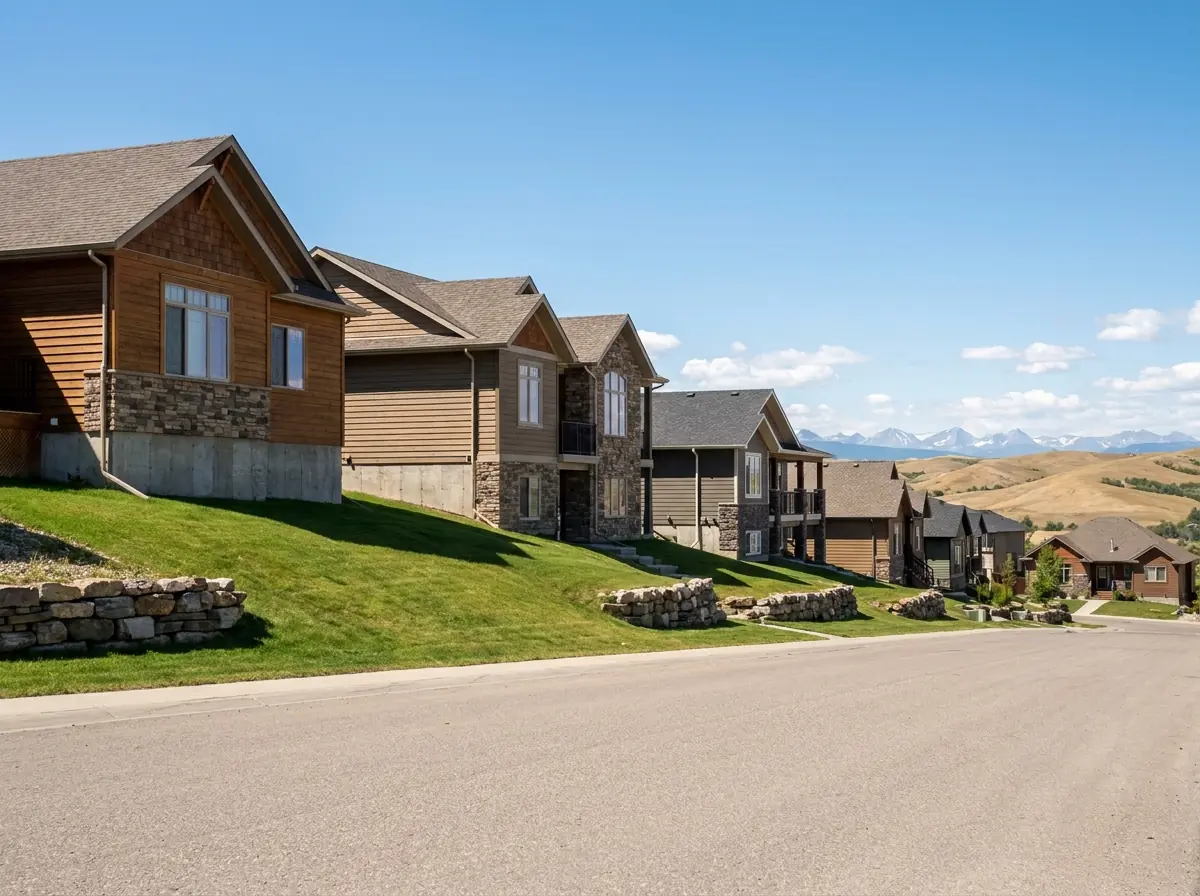
Cochrane divides cleanly between an older core along the valley and the hillside communities that have gone up since the 2000s. The newer ones sit on real slope, which matters more here than material does: grade works in your favour on a run heading downhill and against you on one that is not, and a belly in a line on a hillside lot behaves differently from the same defect on flat ground.
Cochrane is two towns for our purposes, and the line between them is not age so much as elevation. There is the older core down along the valley, and there are the communities that have gone up the hillsides since the 2000s. Most of what is buried under the newer ones is plastic and most of it is young, so on material grounds alone you would expect very little to be wrong — and on material grounds alone, very little is. What is different here is the ground it was laid in, because a great many of these lots have real fall across them.
Grade is the variable nobody thinks to mention on the phone, and it decides a surprising amount. A lateral running downhill from the house to the main carries solids on slope that a flat run has to move on volume alone, which is why a partially obstructed line on a steep Cochrane lot can behave perfectly for months and then fail all at once. Run it the other way — house low, main high, or a long stretch that flattens out at the bottom of a driveway — and the same obstruction announces itself early and often. Neither situation is worse. They just produce completely different symptoms from the same defect, and a homeowner who has been told their drain is fine because it drains is being told something the slope arranged.
That is also why a belly matters more here than the word suggests. Standing water sitting in a low spot with the pipe wall sound either side of it. Clean pipe with one specific defect, rather than a line failing all over. On flat ground a shallow low spot is a nuisance that catches paper. On a hillside run it sits at the bottom of a length of pipe that is delivering everything above it at speed, and it collects accordingly. The method consequence is firm rather than a matter of taste, and our own material notes put it plainly: A bellied ABS line is the clearest case there is of lining being the wrong answer: a liner follows the host, so it will faithfully reproduce the belly and the water will still sit in the same low spot afterwards. That is a bursting or a dig job.
When bursting is the answer on a sloped lot, what gets pulled in behind the head is HDPE, and its relevant property is not strength but jointlessness — specified for a service life measured in generations rather than decades, which is the reason bursting is worth doing at all A fused run has no joints in the ground at all, so the failure mode that finished the old line does not exist in the new one. That is worth more on a graded lot than on a flat one, because a hillside yard with terracing, retaining and mature landscaping across it is the kind of surface nobody wants opened twice.
Most likely under a Cochrane property
Ordered most to least likely, with how each one fails. This is a generalisation about an area and never a statement about one address.
- PVCcommon from roughly the 1970s and 1980s onward, and the default in newer construction
- Same story as ABS — the pipe outlives the problem. Bellies from poor bedding, crushing from heavy equipment over a shallow run, and root intrusion at a gasketed joint that was not seated properly.
- ABScommon in Canadian construction from roughly the 1970s onward
- The material rarely fails on its own. What fails is the installation: a belly where bedding settled and now holds standing water, a crushed section where something was driven over it, or a joint that was cold-welded badly on the day.
- Vitrified claycommonly found in homes built before roughly the 1960s, and in some areas later than that
- It fails at the joints, not in the middle of the pipe. Every joint is a seam a root can find, and a mature boulevard tree has had decades to find all of them. Joints also offset as the ground moves, leaving a lip that catches everything passing over it.
- Copperthe common water service material through much of the later twentieth century and still installed today
- Pinhole leaks. Copper corrodes from the outside where soil chemistry is aggressive to it, and from the inside where water chemistry is. A service can leak for a long time underground before anything shows at the surface.
Material and era are trade generalisations, not a record of what is under any particular property. What is actually in the ground at an address is settled by a camera, not by the year the house was built.
Who calls us from Cochrane, and why
The calls from the valley core and the calls from the hillsides sound different before we arrive. Down in the older part of town the complaint is usually recurrence — cleared last spring, cleared again this spring — which points at the line rather than at what went down it. Up on the newer slopes the complaint is more often sudden: everything was fine, and then the lowest fixture in the house stopped cooperating. On a stepped lot the basement floor drain is the first thing to tell you there is a problem anywhere in the run, because it is the lowest opening the water can find.
We are a buried-services outfit, not a plumbing shop — no fixtures, no water heaters, no interior supply work, no gasfitting. Everything we own points at the ground between the house and the main: a jetter, a cable machine, a camera with a sonde on it, a bursting rig and lining equipment. The overlap with what people mean by a plumber starts and ends at the drain, and we are happy to be the first call on a drain. What we are actually for is the part after that, when the cleaning does not hold and somebody needs to say why.
Access is the other thing that is specific to this town. Equipment constraints in inner-city Calgary are about lot width and lane access; in Cochrane they are about the change in level between the street and the wall. A pit at each end of the run is a small footprint by any measure, but where it can physically go on a tiered hillside lot is a question worth settling before a quote rather than on the morning of the work — so we walk the fall from the wall to the property line while the camera is still in the pipe.
Specific to Cochrane
- Grade decides the symptom
- The same defect produces different behaviour depending on which way the run falls. A line that drains is not necessarily a line that is sound — on a steep lot, slope can carry an obstructed pipe for a long time before it stops carrying it.
- Valley core and hillside are different jobs
- Recurrence is the pattern down in the older part of town; sudden onset is more common on the newer slopes. We ask which one it is before we ask anything about the house.
- The lowest fixture reports first
- On stepped lots the basement floor drain is the lowest opening in the system, so it shows a problem that actually lives somewhere further out. Where it appears is rarely where it is.
- Access is measured in fall, not width
- What constrains equipment on a Cochrane hillside lot is the level change between the street and the wall, not the gap between the houses. Where the two pits can sit is settled before the quote, not on the day.
Permits and the authority
The Town of Cochrane is its own authority for this work — not Rocky View County, which is a distinction that has caught contractors quoting in from Calgary and a detail worth confirming before anybody starts. We establish what the municipality requires ahead of the job rather than carrying Calgary assumptions across the boundary. If the failure is out toward the main rather than near the house, confirm with the Town who owns the section that failed before it is priced.
Communities and districts we work in
Riversong · Sunset Ridge · Heartland · Fireside · Bow Ridge · Greystone
What we do in Cochrane
Trenchless Sewer Repair
Sewer lines replaced from two pits, not a trench.
Drain Cleaning
Drains cleared, and an honest answer on why.
Water Line Replacement
New water service pulled through, lawn intact.
Water Line Repair
One leak in sound pipe is a repair, not a rebuild.
Commercial & Multi-Residential
Underground work scheduled around your tenants.
Every one of those pages describes the same work wherever it is done. What changes in Cochrane is which of them you are likely to need, and that is what the rest of this page is about.
Questions we get asked everywhere
The general questions have the same answers in Cochrane as they do anywhere else, so they are answered once, in full, on one page rather than restated here with the place name changed.
Next door
Tell us what the line is doing
What came out, where, and roughly how old the house is. Those three answers decide what gets loaded before anyone leaves the yard.