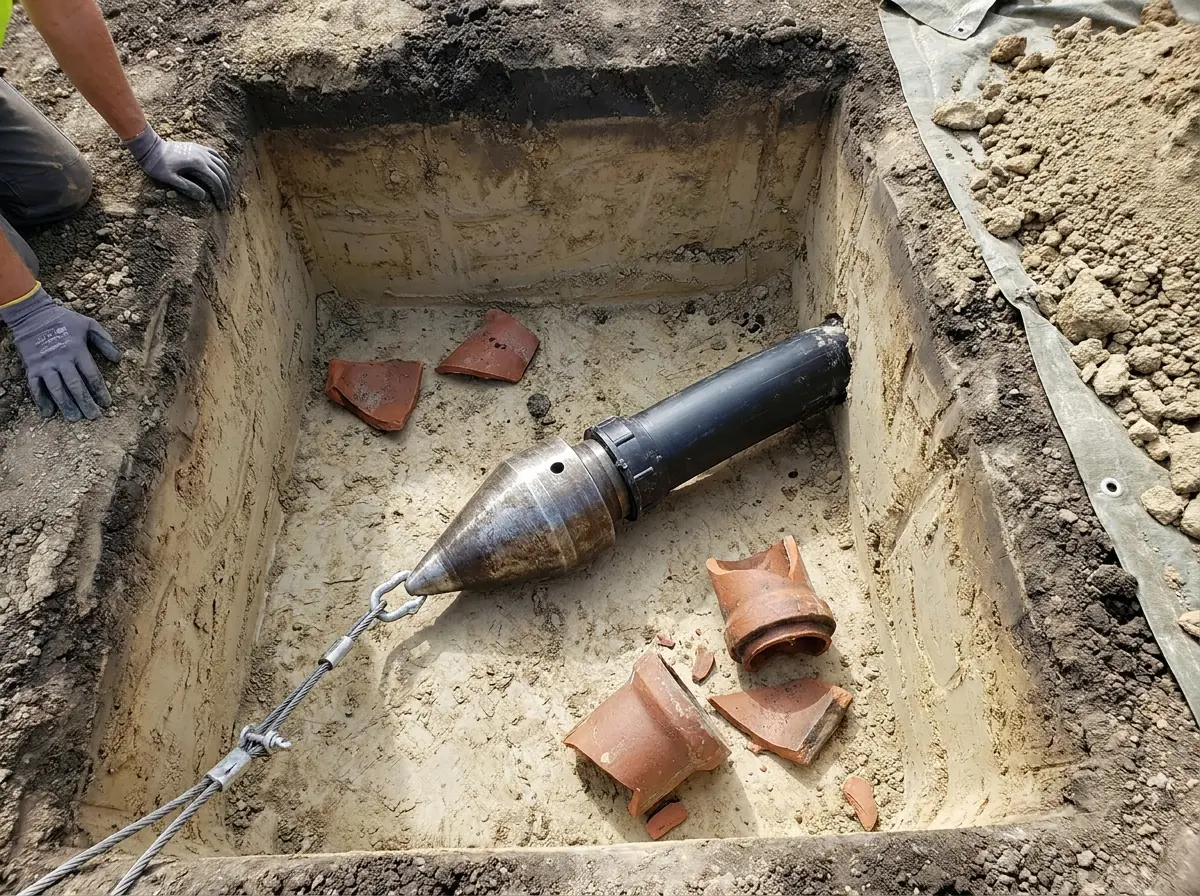
Pipe bursting
Also called static bursting, pneumatic bursting, trenchless replacement
A bursting head is pulled through the old pipe on a cable. It fractures the existing line outward into the surrounding soil and drags a new fused HDPE pipe in behind it in the same pass. The old line is not removed — it becomes part of the ground the new one sits in.
What it needs from the existing line
- Two access pits, one at each end of the run — typically one at the house and one at the property line or the connection.
- A path the head can follow. Severe offsets can stop it.
- Enough clearance from other buried utilities along the run, because the ground is displaced outward as the head passes.
What it cannot do
- It displaces soil sideways. Where another utility runs close and parallel, that has to be established by locates before anything is pulled, and sometimes the answer is that it cannot be done safely.
- It cannot correct a line that is in the wrong place or at the wrong grade — the new pipe follows the path of the old one.
- Two pits still have to be dug. This is trenchless, not excavation-free, and the pits are real holes in real ground.
- Existing connections along the run — a branch from a second building, a garage drain — are severed by the burst and have to be re-established separately.
- What the property looks like
- Two pits rather than an open trench across the yard. Driveways, mature trees, patios and fences between the pits are generally left alone, which is usually the entire reason the method is chosen.
- Right when
- A line that is failing along its whole length, or one too deformed or collapsed to line.
- Wrong when
- A line with one defect and sound pipe either side of it — that is a spot repair or a lining job, and bursting the whole run is buying far more than the problem requires.