Trenchless Sewer Repair Cost
What actually drives the price of a trenchless sewer repair in Calgary — length, depth, material, access and what is on the surface above the line.
Most people reading this already have a number. Either one arrived and there is nothing to measure it against, or two arrived and they are so far apart that one of them has to be describing a different job. That second situation is the common one, and it is usually not dishonesty — it is two contractors pricing two different scopes of work and calling both of them a sewer repair.
There is no figure on this page. Not a range, not a per-foot number, not a starting point. A published average is an average of other people's yards, and the two things that move a sewer number most — what the pipe turns out to be, and what is sitting on top of it — are exactly the two things an average cannot contain. Publishing one would make this page more satisfying to read and would not make your number any more predictable. What is here instead is the list of things that actually set it, so you can read your own quote and see which of them the person who wrote it had actually established.
People ask what a liner typically costs and the honest answer is that four things set it and a camera settles all four: the length of the run being lined, the condition of the host pipe and therefore how much cleaning has to happen before anything is lined, how many branch connections the liner will cover and have to be reopened afterwards, and how the line is reached. A camera survey before and after. Lining a pipe you have not looked down is guesswork. A liner figure quoted over the phone is a length nobody has measured through a pipe nobody has seen.
What the day actually looks like
The quote comes after the camera, not before it, and that order is the whole of our pricing policy. The inspection establishes the material, the located position and depth of the defect, the length of the run and whether there is a cleanout to work through. Only then is there a scope worth putting a number against — and the scope is written down, itemised into the pipe work and the making-good, so the parts can be compared against somebody else's quote line by line rather than total against total.
Two things can move a number after that, and you should know which of them applies before you sign anything. The first is what gets found once a pit is open, which is genuinely unknowable beforehand on some properties and is why a quote can carry a stated allowance for it. The second is scope creep that was predictable and simply was not established — a branch connection nobody looked for, a cleanout that does not exist, a depth nobody confirmed. The first is the ground being the ground. The second is a quote that was written quickly. A number that can never change under any circumstances is not necessarily the better deal either; it usually means the risk has been priced in and you are paying for it whether or not it happens.
What decides the scope
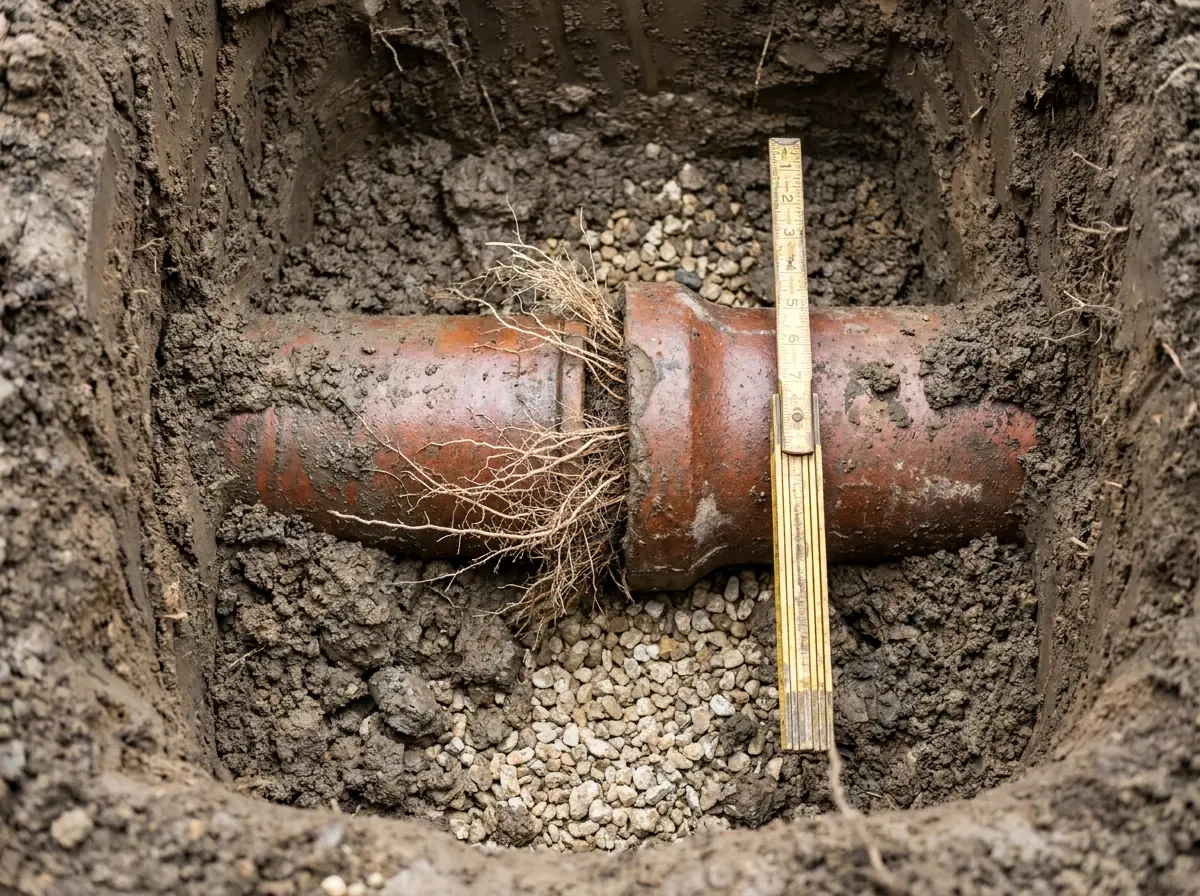
Length is the obvious driver and depth is the one people underestimate. A deeper line means bigger access pits, shoring, more spoil to move and put back, and a slower dig at both ends — depth compounds through the whole job rather than adding to one line of it. Then the host pipe, which decides which methods are available and therefore what the cheapest available answer even is. A pipe that can be lined has an option on the table that a collapsed one does not. Orangeburg is the clearest example: Wood pulp bound with coal tar pitch — cardboard, functionally. It was cheap, light and quick to install, and it was never going to last as long as the house. It is a material frequently reaching end of life within thirty to fifty years, and any that remains in service is well past the age it was designed for, and finding it on camera is frequently the largest single swing between one quote and another, because it takes the cheaper half of the menu away. Add a reinstatement for every branch connection along a lined section, because each one is a separate operation after the liner is in.
Everything else is above the pipe rather than in it, and on a finished property that is frequently the larger half of the job. An open trench along the line, and a restoration job afterwards that is frequently more expensive than the pipe work itself. That is the arithmetic trenchless work is trying to beat: a driveway, a patio, a mature tree and a fence line between the two pits are all cost that is never incurred, while a run across open lawn with nothing on it removes most of the advantage and can make digging the cheaper answer outright. Access sets the rest — a lot reachable only from a lane, or a pit that has to land in a tight side yard, changes what equipment can be used before it changes anything about the pipe.
What people get wrong about this
Two quotes are rarely the same scope
Before comparing totals, check four things in each: whether cleaning the line is included or extra, whether reinstating the surface is included or left to you, how many branch reconnections are allowed for, and what happens to the number if the depth turns out to be greater than assumed. Two quotes that differ on all four are not competing — they are describing different days.
Restoration is not always the same trade
Backfilling and reinstating the pits is part of the job. Matching a stamped or coloured driveway, relaying a specific paver pattern or replacing a section of finished hard landscaping is often a specialist trade and may sit outside a sewer contractor's scope. Ask which it is before the work, not after somebody has left a patch in it.
The cheapest number usually has the least behind it
A quote produced without a camera has assumed the material, assumed the depth, assumed the length and assumed there are no branch connections. It can only move in one direction once work starts. That is not always a trick — sometimes it is simply a fast estimate honestly given — but it is not comparable with a quote written off footage, and it should not be treated as though it is.
Cheapest to fix is not the same as least to spend
Repairing the same line twice costs more than replacing it once, and the camera is what tells you which side of that line you are on. The reverse is equally true: a full replacement on a line with one defect in it is money spent on pipe that had years left.
When this is the wrong answer
Two cases where this is the wrong page for you. If you rent, or the failed line serves a condominium, townhouse or shared building, the cost question is very probably not yours to answer — it belongs to the landlord, the board or the property manager, and the useful next step is finding out who instructs the work before anyone prices it. And if the defect sits beyond the property line, confirm with the City who owns the section that failed before you budget for a metre of it. We will show you on the footage exactly where the defect is and how deep; who is responsible for that section is a question for the City, and we will not answer it for them.
Questions about sewer repair cost
The ones that come up on this work specifically. The general questions are answered on the FAQ page.
What is the typical cost of a CIPP liner?
Why will you not give me a number over the phone?
What makes one job cost more than the same job next door?
People also ask
Answered in full, once, on the page each one belongs to — rather than repeated on every page of this site.
Nothing is quoted off a description
The camera goes down first and you keep the footage. If the answer is that there is nothing wrong with your line, that is what you will be told.