Sewer backup in Calgary
Sewage coming back up into a Calgary basement. What to do in the first ten minutes, and what the line is likely telling you.
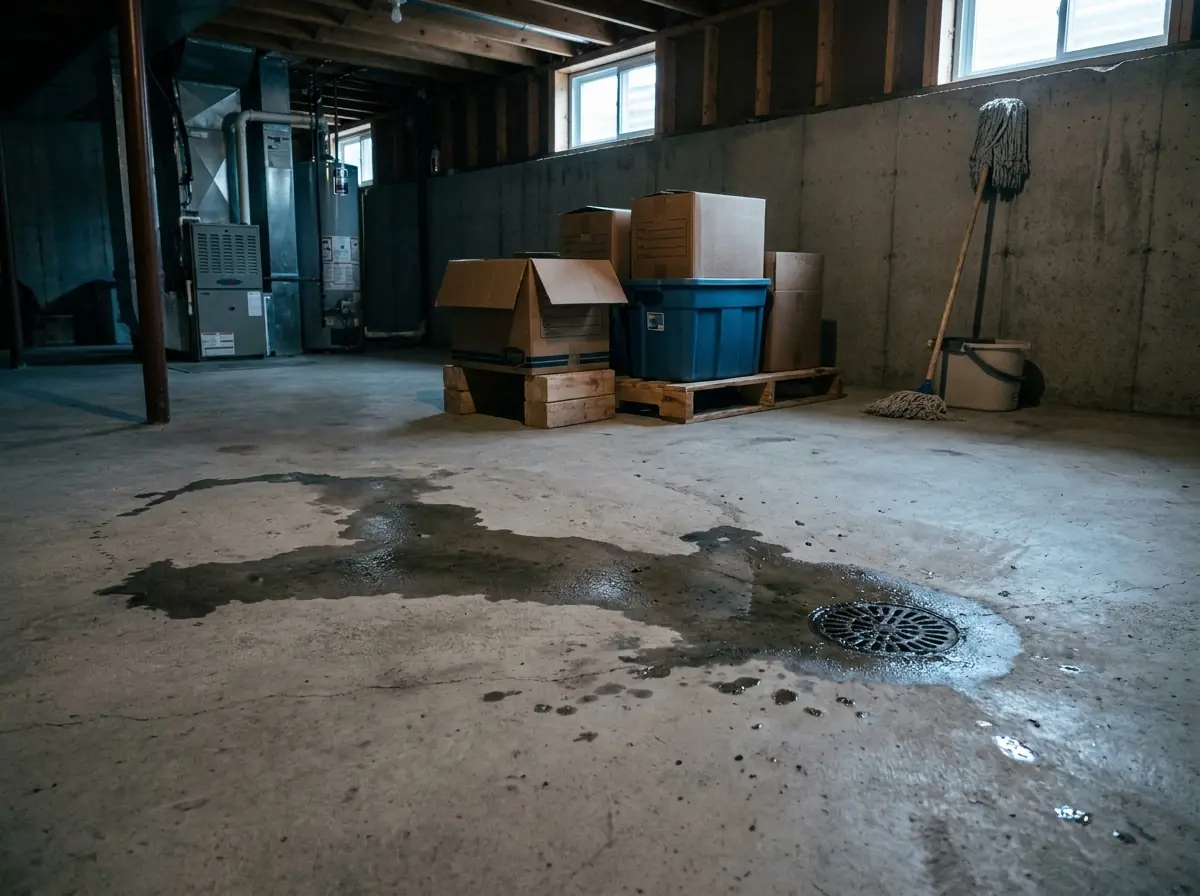
Everything in a house drains to one line. Sinks, tubs, toilets, the laundry, the furnace condensate — all of it converges on a single lateral running out under the yard to the connection. When that line cannot move what it is given, the water does not stop arriving; it stacks up and then leaves through the lowest opening in the building. That is the floor drain, the laundry standpipe or the basement shower, and it is why the mess appears in a room that had nothing to do with causing it. The basement is not the problem. The basement is the low point.
Underneath that symptom sit two entirely different situations, and from where you are standing they look identical. Either there is a defect in your own line — roots, a collapse, an offset joint, a low section holding water — or your line is fine and the system it drains into is full, so there is nowhere for yours to go. The second one is surcharge, and it has a different signature: it tends to arrive during heavy rain or a fast melt rather than at random, it often affects more than one house on the street at the same time, and it can clear on its own when the water goes down. Knowing which of the two you had is the entire difference between a repair that solves it and a repair that changes nothing.
That distinction is also where the question of who owns which section of pipe comes in, and it is a question worth putting to the City directly rather than taking any contractor's word for. Confirm with the City who owns the section that failed. We will tell you what the camera found and where it is, measured and located; what the responsibility for that particular length of pipe is, is theirs to state and not ours.
How sewer backup runs, step by step
-
Step 1
Stop adding to it
Nothing down any drain in the house until the line is clear — every flush and every load of laundry has to go somewhere.
-
Step 2
Clear the line
Getting the blockage out is the first job, before anything is diagnosed and before anything is quoted.
-
Step 3
Camera to find the cause
A backup is a symptom. Roots, a collapse, a belly and a one-off obstruction all look identical from inside the basement.
-
Step 4
Backwater valve conversation
Where the cause is surcharge rather than a defect in your own line, the answer is a different piece of equipment entirely.
-
Step 5
Document everything
Footage and a written condition report, because you may need to show someone what happened and why.
What the day actually looks like
The camera is where a backup stops being a mystery. It goes down the line with a sonde in the head, so every defect it finds gets a position and a depth rather than a description, and what it shows is usually specific to the material. In vitrified clay: Root masses entering at regular intervals, matching the joint spacing. Offset joints showing a step in the pipe wall. Often a long run of sound pipe between two bad joints. In Orangeburg, which is the one nobody wants: An unmistakable oval or egg-shaped bore. Blistering and peeling of the inner wall. Often the camera simply cannot pass. In ABS or PVC the camera is looking for one event rather than a condition, and the list of candidates is short. Same story as ABS — the pipe outlives the problem. Bellies from poor bedding, crushing from heavy equipment over a shallow run, and root intrusion at a gasketed joint that was not seated properly. A line that is failing generally and a line with one thing wrong with it behave the same way on the night, and look nothing like each other on the screen the next morning.
What comes out of that is a record — the footage, and a written condition report saying what the line is made of, what was found and where along the run it sits. We will not tell you what any of it means for your policy. Policies differ, we are not your adjuster, and a contractor volunteering an opinion on your coverage is doing you no favours at all. What we will do is make sure that when someone does ask what happened, there is footage of the inside of the pipe rather than a recollection of a bad Tuesday. That record is also what makes the repair decision arguable: you can look at the same screen we are looking at and disagree with us.
What decides the scope
If a repair follows, the scope is set by the camera and not by the severity of the backup. Where the defect sits along the run matters most — a fault close to the house and a fault out near the connection are different excavations and sometimes different methods. Then depth, what the line is made of, how far the whole run is, and what is on the surface above it: a driveway, a patio or mature trees over the line are the reason trenchless methods exist, and a bare side yard over a short run is the reason digging is sometimes simply the cheaper answer. None of that is knowable from the basement.
A backwater valve, where one is in scope, is a separate piece of work with its own drivers — it needs a position on the line that can be excavated, and it has to stay reachable afterwards, because a valve nobody can get to is a valve nobody maintains. It is not a repair to the pipe and it does not pretend to be one. It addresses the surcharge case: the line filling from the far end and pushing back towards the house.
What people get wrong about this
Treating the second one as bad luck
One backup can genuinely be one obstruction. The same line backing up twice inside a year is the pipe telling you something about itself, and at that point looking is cheaper than clearing it a third time. Most of the lines that end up being replaced had given two or three warnings first.
A backwater valve is not a repair
It stops the system pushing back into the house. It does nothing whatsoever about roots in your own lateral, a collapsed section or a belly — those are still there and still yours. It also closes when it is working, and while it is closed the house cannot drain into the line either. Fitting one to a house whose problem is a defect in its own pipe buys a device and leaves the fault in the ground.
Blaming the tree in the yard
Material decides whether roots are even plausible. A jointed line under a mature boulevard elm is one story; a long plastic run under a young tree in a newer community is another, and root intrusion there is uncommon enough that the camera usually finds something else entirely. The tree is the obvious suspect and frequently the wrong one.
Expecting the cause to be visible from the basement
The mess is at the low point of the building. The defect is commonly out under the yard, sometimes near the property line, and the distance between the two is exactly why the camera carries a locator. Nothing anyone can see from inside the house narrows it down, and a diagnosis offered without looking is a guess wearing a uniform.
When this is the wrong answer
A single backup traced to one obstruction in sound plastic pipe does not need a line replacement, and you will hear us say so with the footage still on the screen. Where the camera shows PVC and a single blockage, the answer is usually a cleaning rather than a replacement. That is the whole recommendation, and there is nothing behind it. Where the cause turns out to be surcharge from beyond your property rather than a fault in your own lateral, replacing your lateral changes nothing at all; that is a valve conversation and a question to put to the City about the section that failed, and spending on new pipe first would be spending in the wrong place. And where the line genuinely is finished, what to do about it is decided by what the pipe is made of and where the damage sits — not by how bad the night was. A collapsed line and a bad smell can come from the same house, and only one of them is an argument for digging.
Questions about sewer backup
The ones that come up on this work specifically. The general questions are answered on the FAQ page.
Why does it come up at the basement floor drain?
Will a backwater valve stop this happening again?
Does a backup mean the line has to be replaced?
People also ask
Answered in full, once, on the page each one belongs to — rather than repeated on every page of this site.
Nothing is quoted off a description
The camera goes down first and you keep the footage. If the answer is that there is nothing wrong with your line, that is what you will be told.