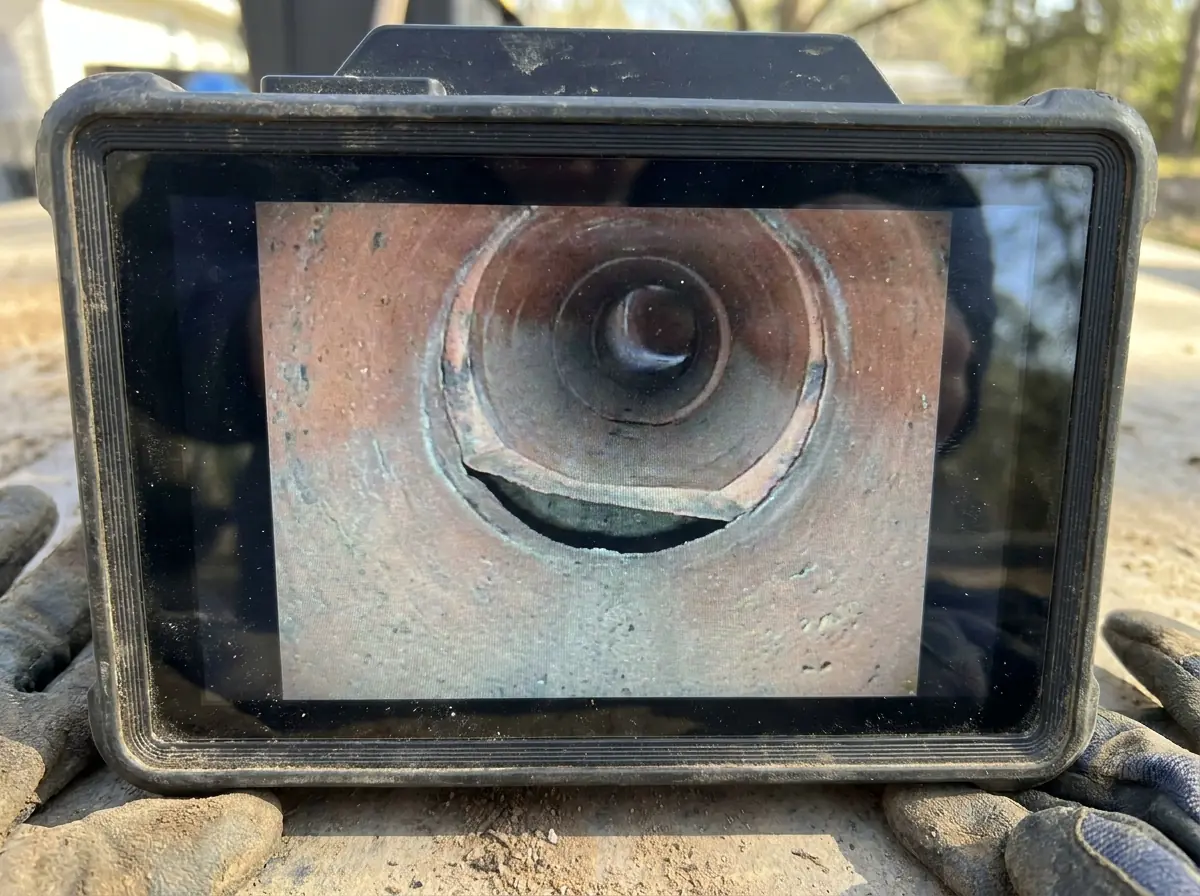
What a sewer camera inspection actually shows
Most homeowners meet a sewer camera in one of two situations: something has backed up, or somebody has quoted a large number and the camera is the thing that is supposed to justify it.
Either way it is worth knowing what the operator is actually looking at, because the footage is the evidence for every recommendation that follows and you are entitled to watch it, keep it, and ask what you are seeing.
What the equipment is
A camera head on a flexible push rod, fed into the line through a cleanout or an accessible opening and driven the length of the run. Lights on the head, a screen at the other end, and — the part people underestimate — a sonde.
A sonde is a small transmitter in the camera head. A receiver at the surface picks it up, so anything found on the screen can be located on the ground above it, and at what depth. Without that, footage tells you a pipe is broken somewhere. With it, you know where to stand.
That is the difference between a survey and a look, and it is what makes the footage useful for planning a dig, a pit or a repair.
The four questions the survey is answering
Everything on the screen is in service of these. An operator who cannot answer all four at the end of a survey has not finished it.
1. What is the pipe made of?
This rules out more options than anything else, so it comes first. Each material has a look on camera that is hard to confuse once you have seen it.
Clay:
Root masses entering at regular intervals, matching the joint spacing. Offset joints showing a step in the pipe wall. Often a long run of sound pipe between two bad joints.
Cast iron:
A rough, tuberculated interior that snags the camera. Channelling along the invert where the bottom has worn away. The pipe can look intact from above and be gone underneath.
Orangeburg:
An unmistakable oval or egg-shaped bore. Blistering and peeling of the inner wall. Often the camera simply cannot pass.
Concrete:
Exposed aggregate on the crown where the paste has gone. A visibly rough upper wall against a smoother invert.
ABS:
Standing water sitting in a low spot with the pipe wall sound either side of it. Clean pipe with one specific defect, rather than a line failing all over.
PVC:
Long clean runs. A defect in PVC is usually one identifiable event at one location, not a line-wide condition.
Two of those decide the job on sight. Orangeburg cannot host a liner, so finding it settles the method. Long clean plastic with one defect usually means there is nothing to repair at all.
2. Does the pipe still hold its shape?
A cured-in-place liner cures against the host pipe. The host is the mould. So round pipe can be lined and deformed pipe cannot, and this is the single observation that separates a lining conversation from a replacement conversation.
What the operator is watching for: the bore going oval, the pipe wall coming away from itself, a section the camera cannot pass at all. A camera that stops is not a failed survey. It is a finding.
3. Where are the defects, and how many?
This is where the footage earns its keep, because it decides whether you are buying a patch, a liner or a new line.
One defect with sound pipe either side is a spot repair — a short liner over one place, with the rest of the line left alone because the rest of the line is fine.
Defects at every joint for the length of the run is a full-length answer. A line with six bad joints does not want six patches; at some point the whole-run repair is both cheaper and better, and a deteriorating clay line will keep producing new defects at the seams the patches did not cover.
Where that crossover sits is a judgement made off the footage, not off a rule, and it is a fair thing to ask an operator to justify.
4. Is the pipe the problem at all?
The answer that costs us money and keeps the rest of this credible.
A blockage in a sound line is a cleaning. Grease, wipes, sediment, a root mass in an otherwise serviceable pipe. If the footage shows long clean plastic and one obstruction, that is a drain job, and anyone who quotes a replacement off it should be asked to point at the frame that justifies it.
Things that show up and are easy to misread
Standing water. Water sitting in the pipe with sound wall either side is a belly — a low spot where the bedding settled. The pipe is not broken. The geometry is.
This is the one that costs people money, because a belly does not look like damage. It looks like a puddle. And it is the defect a liner cannot fix, because a liner reproduces the geometry it is given: the new pipe will hold water in exactly the same place. A bellied line is a re-lay, which means bursting or digging.
Roots. Roots do not break into sound pipe. They find an opening that already exists and thicken inside it. So the question the footage answers is not whether you have a tree — it is how many openings your pipe has. Regular intervals matching joint spacing means the pipe is made of openings. The Calgary version of that problem is here.
Scale and tuberculation. Common in cast iron, and it does two things at once: it narrows the bore, and it hides the pipe wall. A cast iron line frequently has to be descaled before it can be properly assessed — and sometimes the descaling is what reveals the pipe is past lining. Any lining scope committed to on cast iron before cleaning is a commitment made without the evidence.
A camera that will not pass. Could be a collapse, a severe offset, a heavy root mass, or the head finding the wrong way at a junction. It is a reason to investigate further, not a conclusion on its own.
Standing water hiding everything. A camera cannot see through a full pipe. On a line that is currently backed up, the blockage generally has to be cleared enough for the camera to travel before the footage means anything. That is why the honest sequence on an active backup is often clear it, then survey it.
What a survey does not do
Worth being straight about.
- It does not see through the pipe wall. It shows you the inside surface. Soil conditions, bedding and what is buried alongside the run are established by locates and by digging, not by looking down the bore.
- It does not settle who is responsible for what. Where a lateral changes hands between the property and the main is a question for the City, and the answer belongs to them rather than to a contractor. Ask them about the section that failed before anyone quotes work on it.
- It does not predict how long you have. It shows you a condition on a day. Nobody can put a number of years on a pipe from footage, and anybody who does is inventing it.
- It is not a water-line tool. Water services are too small for this. A failed water service is found with acoustic leak detection, pressure testing and correlation, not with a camera.
What you should ask for
Three things, and none of them are unreasonable.
Watch it live, or get the recording. Preferably both. A survey whose footage you never see is a story about a survey.
Ask for distances. Every finding should come with how far along the run it is. That is what the push rod’s markings and the sonde are for, and it is what lets a second opinion check the first one.
Ask what rules out the cheaper option. If the recommendation is a full-length replacement, the footage has to show why a spot repair will not do. If the recommendation is lining, it has to show why the pipe will hold its shape. Those are answerable questions and the answer is on the screen.
Why we do this before quoting
We camera the line before we quote it. That is the whole positioning, and the reason is not customer service — it is that a recommendation about buried pipe without footage is a guess, and a guess with a price on it is worse than no recommendation at all.
It also cuts the other way, which is the part that matters. A camera that shows sound plastic and one blockage means we tell you that you have a blockage, clean it, and leave. That answer is right often enough in the newer communities that a company unwilling to give it should not be trusted with the interesting cases either.
Book a survey · Is your line collapsed? · What the materials mean
Want the line looked at?
Nothing here gets quoted off a description. The camera goes down first, you watch the screen, and you keep the footage — including on the jobs where the answer turns out to be that nothing needs replacing.