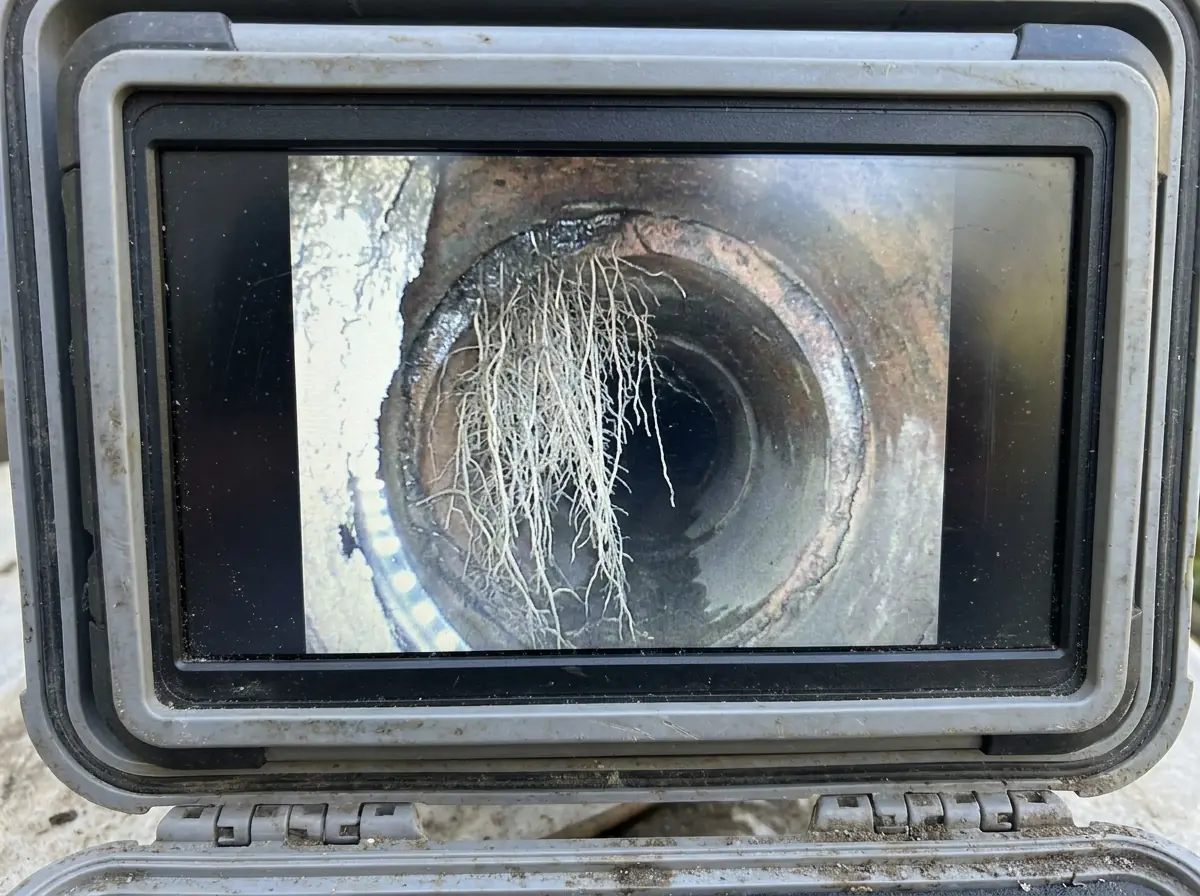
Tree roots in a sewer line: the Calgary version of the problem
Two houses, same street, same tree species out front, same age. One has roots in the sewer line every spring. The other has never had a problem. People assume the difference is the tree. It is almost never the tree.
Roots do not break into sound pipe. They are not strong enough and they do not need to be. What a root does is find an opening that already exists, get a fine tip through it, and then thicken — and a root thickening inside a joint has more than enough force to lever it wider.
So the question is never “do I have a tree”. It is “what openings does my pipe have”.
Where the openings are
This is where Calgary splits cleanly in two, and where the honest advice differs completely depending on which half you live in.
Jointed clay, in the older communities. Fired clay laid in short lengths, with a bell-and-spigot joint between every one of them — a seam every few feet for the whole run. Every seam is a candidate. On camera the pattern is unmistakable: root masses entering at regular intervals, and the intervals match the pipe lengths. That is not a tree that got lucky. That is a pipe made of openings.
Long-run plastic, in the communities built from the 1980s onward. ABS and PVC go in as long lengths with solvent-welded or gasketed joints — very few of them, and the welded ones are chemically fused rather than seated. There is almost nothing for a root to enter. Root intrusion out there is possible, but when it happens it is usually one gasketed joint that was not seated properly on the day, at one identifiable location, rather than a line-wide condition.
If you are in a newer community and something is backing up, the odds are strongly against roots being the cause, and anybody who leads with roots before looking is guessing. It is far more likely to be a blockage, and more likely still to be something that went down a drain rather than something that grew into one.
Cast iron and concrete have their own versions of this. Concrete joints offset and admit roots the same way clay does. Cast iron corrodes from the inside and fails through the invert, which is a different problem with a similar symptom.
The elm
What makes this a Calgary post rather than a generic one is what is growing over the older half of the city.
Calgary carries one of the healthiest mature American elm populations left in North America. It is a real civic asset and it is the reason those streets look the way they do. It is also a large, broad, patient root system sitting directly above a great many jointed clay laterals, with decades to have worked over every seam in them.
That combination — mature elm over jointed clay — is the single most common structural cause of sewer trouble in this city. It is concentrated in a handful of older communities rather than spread evenly, which is why one part of town has a reputation for sewer work and another does not.
A practical note before anyone plans a trench: a boulevard tree may not be yours to make decisions about. That is a question to put to the City before it becomes a question for your contractor.
What the symptoms actually tell you
Roots tend to announce themselves the same way every time.
- Slow drains that get worse over months, then recover completely after a cleaning, then repeat. That cycle is the signature. A one-off blockage does not come back on a schedule.
- The whole house slows, not one fixture. One slow sink is a fixture problem. Every drain in the house draining slowly is a main line problem.
- A seasonal rhythm. Root growth is not constant through the year, and a line that only ever backs up at the same time of year is telling you something.
- Gurgling from a floor drain or a toilet when something else drains. Air finding its way past an obstruction.
None of that identifies which opening the roots came in through, how many of them there are, or what the pipe is made of. Only footage does that.
Jetting: what it is and what it is not
Hydro jetting is high-pressure water through a nozzle that pulls itself up the line, cutting roots and stripping the pipe wall on the way back. It is a genuinely good tool and it is a real improvement on a cable snake, which punches a hole through a blockage and leaves the rest of it sitting there.
Two things you should be told before you buy it.
It treats the symptom. Where roots are the problem, jetting removes what has grown in. The joint they came in through is still open. They grow back. That is not a failure of the work, it is the nature of the work, and anyone who sells jetting as a permanent answer to root intrusion is misrepresenting it.
It cannot be used safely on a pipe that is already failing. The pressure that cuts a root mass can finish a badly deteriorated line. This is the reason the camera goes in first. It is a precondition, not an upsell, and a company that will jet blind is a company that has decided your pipe is your risk.
When yearly jetting stops making sense
There is an arithmetic point in this and it is worth naming plainly, because most people arrive at it without noticing.
If you are cleaning the same line every year, you are buying the same day over and over, and the pipe is getting no better in between. At some number of repeats, the permanent fix costs less than continuing — and the permanent fix is the one that removes the openings.
Lining forms a new jointless pipe inside the old one. No joints means no seams, and no seams means nothing for a root to enter. On a clay lateral with root intrusion at the joints and sound pipe in between, that is the textbook case for it.
Where the line is too far gone to host a liner, bursting pulls in a new fused HDPE pipe with no joints in the ground between the pits at all.
Either way the mechanism of the fix is the same: remove the openings, and the roots have nothing to find. Not chemicals. Not a stronger jetter. Not a more aggressive cutting head.
What we would actually do
Camera the line first, and tell you which of the two Calgarys you are in.
If the footage shows long clean plastic runs and one blockage, we will tell you that you have a blockage, clean it, and leave. That is a dull answer and it is frequently the right one.
If it shows clay with root masses at the joints, we will show you where they are, how many, and whether the pipe between them is sound — and then the conversation is a real one about whether you are buying another year or buying the last year.
Want the line looked at?
Nothing here gets quoted off a description. The camera goes down first, you watch the screen, and you keep the footage — including on the jobs where the answer turns out to be that nothing needs replacing.