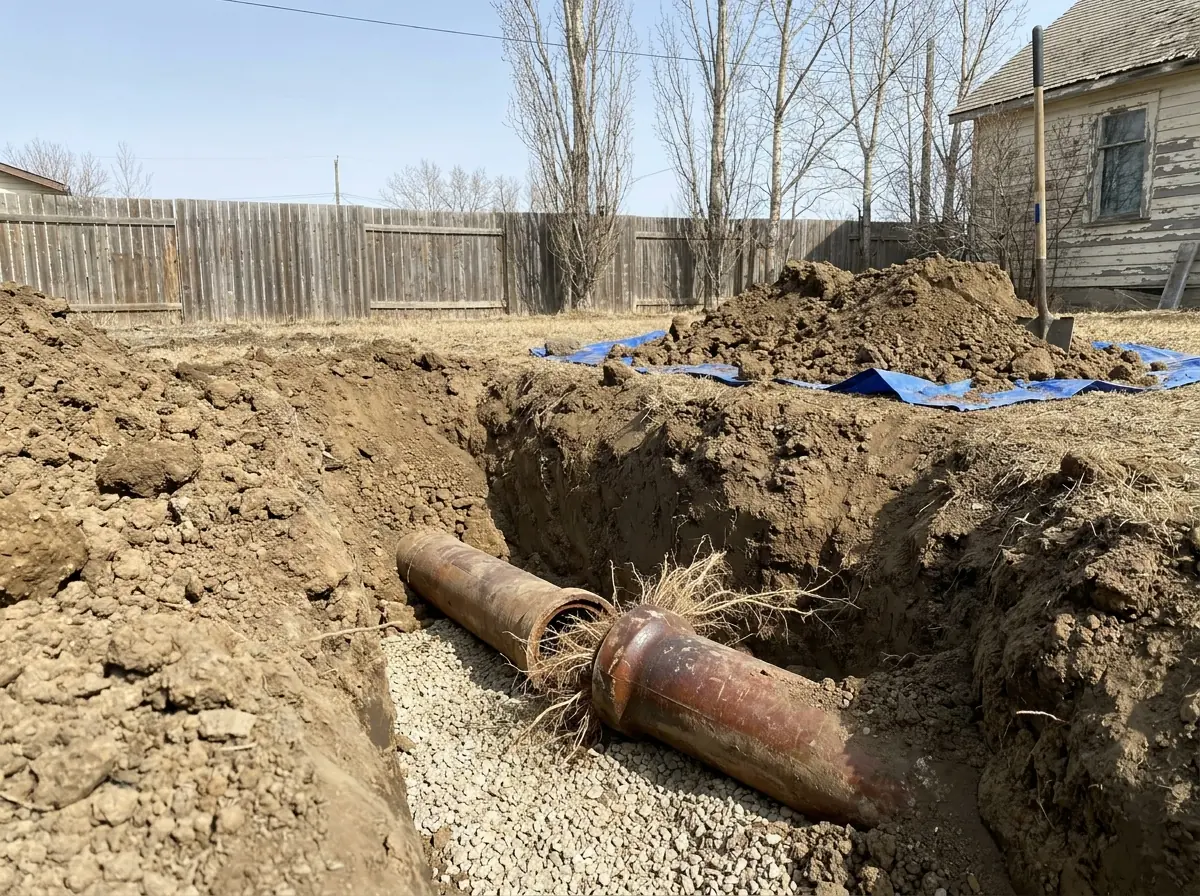
When you should just dig
We replace and reline buried pipe without trenching the yard. It is the whole business. So this post is written against our own interest on purpose, and it exists because of something that is true of every trade with a headline method:
A method described only by the people who sell it always reads as the best one available. Read two such pages back to back and you believe neither. The only way a recommendation means anything is if the person making it can tell you when the answer is something else.
Here is our something else, as it is recorded in our own method file:
Digging the line up. It is frequently the right answer, and often the cheaper one — a short run under bare lawn can cost less to open than it does to mobilise trenchless equipment for.
That sentence is in a file we wrote for ourselves. It is not a concession made at a quote.
First, the comparison that actually decides it
Almost everybody compares the pipe work, and the pipe work is rarely the expensive part.
Trenching a line has two costs: opening the ground, and putting it back. On a finished property the second routinely exceeds the first. An excavator does not care what is on the surface. The reinstatement cares entirely, and it is priced by what was there:
It takes out whatever is above the line — lawn, driveway, patio, mature tree roots — and reinstatement is often the largest part of the cost.
Trenchless replaces the same pipe from two pits and leaves the ground between them alone. So the honest comparison is the restored property against the restored property — not pipe against pipe.
Which means the whole question reduces to one thing: how much is standing on top of your line?
If the answer is a driveway, a patio, a stone walkway or a forty-year-old tree, trenchless is very often the cheaper finished job and it is not usually close. If the answer is grass, keep reading, because the arithmetic runs the other way and the rest of this post is the six cases where it does.
1. The run is short, shallow and under nothing
The single most common case where digging wins, and it is straightforward.
Trenchless equipment has to be mobilised, set up and operated, and that is a fixed cost that does not shrink with the length of the run. Below some length, an excavator and a day is simply less work than bringing the gear in.
Bare lawn is the cheapest surface on any property to reinstate. Sod goes back. It is not a hardscape repair, it is not a tree, and in a season nobody can tell.
Our own file names this as one of the cases open-cut is best for:
a short run under ground with nothing on it, where digging is simply cheaper than mobilising trenchless equipment
If you are standing on lawn between your house and the street, get a price for digging it before you get a price for anything else. Not after. The trenchless quote is meaningless without it, and the honest version of our sales process is that we would rather you had both numbers.
2. The line has to change grade or route
This one is not about money at all. It is a hard limit, and it kills both trenchless methods at once.
Bursting:
It cannot correct a line that is in the wrong place or at the wrong grade — the new pipe follows the path of the old one.
Lining:
It reproduces the geometry it is given. A bellied line stays bellied, and water will still stand in the same low spot afterwards.
Neither method moves a pipe. One follows the old path; the other follows the old shape. If the fix requires the line to run somewhere else, or to sit at a grade it does not currently sit at, it has to be dug and re-laid. There is no trenchless version of this and no amount of comparison changes it.
The belly is the one that costs people money, because it does not look like damage on a camera. It looks like water standing in the pipe with sound wall either side. The pipe is fine. The bedding under it settled, and the line will block in the same place indefinitely.
Line a bellied run and you get a brand new jointless pipe with the old pipe’s low spot moulded permanently into it. If anyone has recommended lining and the footage shows standing water, ask them about this specifically, and get the answer in writing.
3. The run is too congested to burst safely
The constraint that is not a negotiation.
Bursting works by displacing soil sideways. The head fractures the old pipe outward into the ground around it, and that ground has to go somewhere.
It displaces soil sideways. Where another utility runs close and parallel, that has to be established by locates before anything is pulled, and sometimes the answer is that it cannot be done safely.
Sometimes the answer is that it cannot be done safely. Not that it costs more.
Where a gas service, a water service or something else runs close and parallel to your sewer along part of the run, locates decide it, and a contractor who does not raise this before quoting a burst has not thought about what is next to your pipe. Open-cut has the opposite property: you can see what you are working next to, the whole way along.
4. The collapse is in a spot that cannot be reached from either end
Bursting needs a path the head can follow, and a badly collapsed section is exactly what stops one.
A path the head can follow. Severe offsets can stop it.
Lining needs a host pipe that is still there and still holding its shape:
It cannot fix a collapsed pipe. There has to be a pipe left to line.
So a line that has given up in the middle of the run, with no way through it from either direction, is frequently a dig — sometimes a short one, opening the ground over the failed section rather than the whole length.
Our own file names it:
a collapse in a spot that cannot be reached from either end
5. The pits would land in the worst two places on the lot
Worth walking your property for, because it catches people out after they have already decided on trenchless.
Bursting needs a pit at each end of the run — typically one at the house and one out at the property line or the connection. Those are real excavations:
Two pits still have to be dug. This is trenchless, not excavation-free, and the pits are real holes in real ground.
If both of those land in the two spots on your lot you least want opened — under the patio, through the stone walkway, in the middle of the garden that took fifteen years — then the geometric advantage of the method is already spent before anything is pulled. You are getting two holes in the expensive places and a trenchless price.
Go outside and work out roughly where the line leaves the house and where it meets the street. Those are approximately your two pits.
6. The run is too shallow
A shallow line has less ground above it to take the displacement of a burst, and less ground between it and whatever is on the surface. Our own file lists
a run too shallow or too congested to burst safely
among the cases open-cut is for. The same shallowness that makes bursting harder makes digging easier — there is less to move.
What digging actually costs you, stated plainly
So that nobody reads the above as a sales pitch pointed the other way. The downsides of open-cut are real and they are recorded in the same file as everything else:
It takes out whatever is above the line — lawn, driveway, patio, mature tree roots — and reinstatement is often the largest part of the cost.
It takes longer and leaves the property disturbed for longer.
And what the property looks like while it happens:
An open trench along the line, and a restoration job afterwards that is frequently more expensive than the pipe work itself.
That is the trade-off in one sentence. On bare lawn the restoration is trivial and the method wins. On a finished property the restoration is the job, and that is precisely what trenchless was invented to avoid:
A long run under a finished yard, a driveway or mature trees, where the reinstatement cost dwarfs everything else and trenchless exists precisely to avoid it.
The tree question, which deserves its own paragraph
In the older parts of Calgary the boulevard trees are frequently sitting directly over the run, and Calgary carries one of the healthiest mature American elm populations left in North America.
A trench through a root plate is not a landscaping line item. It is a decision about whether the tree survives. This is the case where the case for trenchless is strongest and least arguable, and it is also the case where the decision may not be entirely yours — a boulevard tree is a question to put to the City before it becomes a question for your contractor.
How this actually gets decided
By looking down the pipe first, and by walking the ground above it second.
The camera survey establishes what the pipe is, whether it still holds its shape, where the defects are and whether there are one or many. That rules methods in and out before cost is discussed at all — a collapsed line cannot be lined, Orangeburg cannot be lined, a bellied line should not be.
Then the surface decides the rest. What is above the run, where the pits would land, what else is buried nearby, how long the run is and how deep.
We camera the line before we quote it, and if what comes back is a short shallow run under lawn with one bad section, we will tell you to get a price for digging it. That is a worse job for us and a better one for you, and a company that will not say it on a quiet Tuesday should not be believed on the day it recommends something large.
The short version
Dig it when the run is short, shallow and under nothing. Dig it when the line has to move or change grade. Dig it when locates say bursting is not safe. Dig it when the collapse cannot be reached from either end, when the pits would land in the two worst places on the lot, or when the run is too shallow to burst.
Do not dig it when a driveway, a patio or a mature tree is sitting on top of the line, because then the reinstatement is the whole cost and trenchless exists for exactly that.
Everything else is detail on one side of that or the other.
Is trenchless worth it? · Bursting against lining · What moves the cost · Book a survey
Want the line looked at?
Nothing here gets quoted off a description. The camera goes down first, you watch the screen, and you keep the footage — including on the jobs where the answer turns out to be that nothing needs replacing.