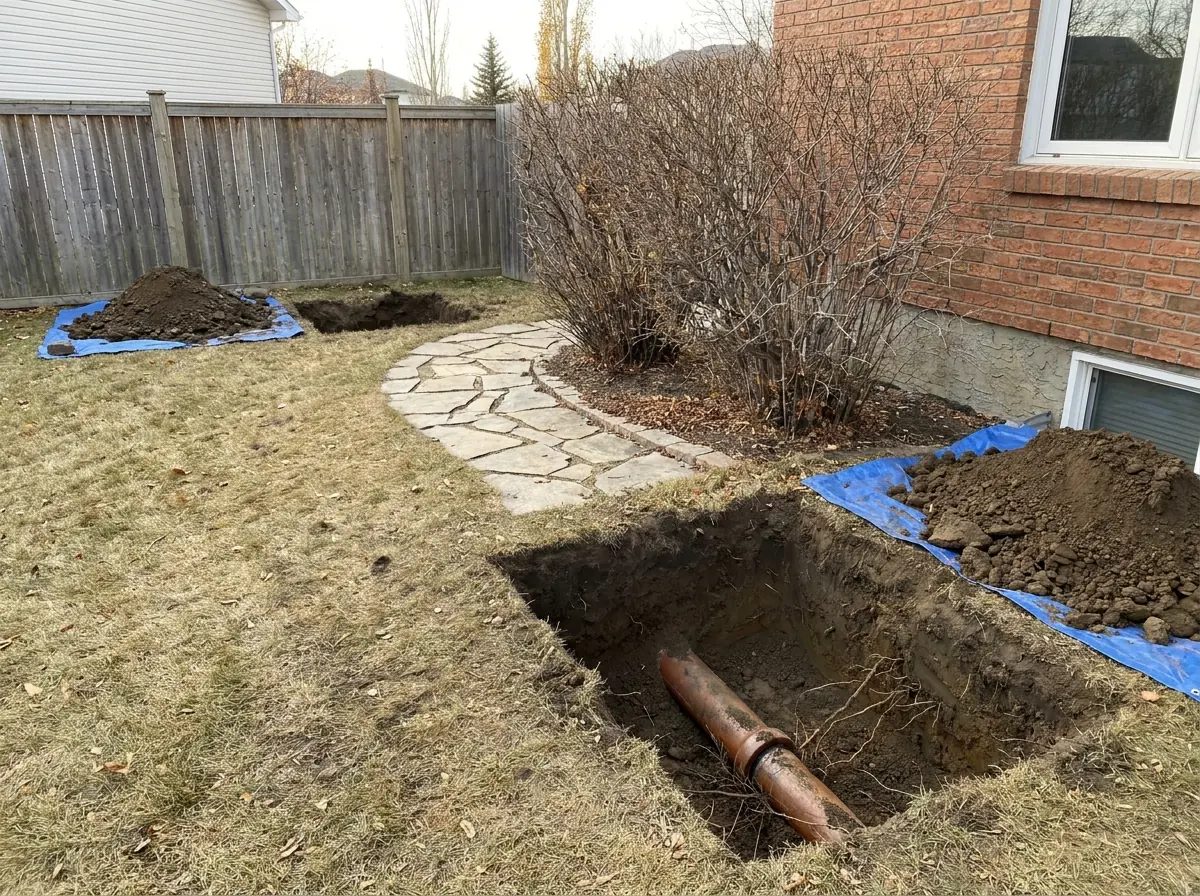
Is pipe bursting cheaper than trenching?
Often. Not always. And the times it is not are predictable enough that you can work out which one you are before anyone comes out.
We publish no figures anywhere, so this post will not give you a number or a ratio. What it will do is tell you exactly which line items move, because those are the same on every job and you can check them against your own property.
The comparison people make, and the one that decides it
Most people compare the pipe work. That is the wrong comparison, and it is the reason the answer feels inconsistent.
Trenching a sewer lateral has two costs: opening the ground, and putting it back. On a finished property the second one routinely exceeds the first. An excavator does not care what is on the surface; it is the reinstatement that cares, and reinstatement is priced by what was there.
Pipe bursting replaces the same line from two pits and leaves everything between them untouched. So the honest comparison is:
trench + everything above it, put back against two pits + the bursting operation
Whichever of those is smaller wins. That is the whole thing.
What makes trenching expensive
Walk the line from your house to the street and count what the trench would go through.
- Concrete and hardscape. A driveway, a walkway, a patio, a garage apron. It comes out, and it goes back as a visible repair.
- Mature trees. A trench through a root plate is not a landscaping item. It is a decision about whether the tree survives. In the older parts of Calgary the boulevard elms are frequently sitting directly over the run.
- Depth. Deeper trench means more spoil, more shoring, more of everything. It does not scale gently.
- Established landscaping. Irrigation lines, lighting, retaining, thirty-year planting. All of it is cheap to remove and expensive to be without.
- Restricted access. A narrow side yard, a fence that has to come down, a lane that has to stay open, spoil that has to be carried rather than loaded.
Where several of those apply, bursting is very often the cheaper finished job — and on a driveway crossing it is not usually close.
What makes trenching the cheap option
This is the half that trenchless companies tend not to write down.
- The run is short and shallow. Trenchless equipment has to be mobilised. Below some length, that mobilisation is simply more than an excavator and a day.
- There is nothing above the line. Bare lawn is the cheapest surface on any property to reinstate. Sod is not a hardscape repair.
- The pits would land somewhere awkward anyway. Bursting needs a pit at each end, and if both of those fall in the two places on your lot you least want opened, the geometric advantage is already spent.
- The line has to change grade or route. Bursting cannot correct a line that is in the wrong place or at the wrong grade — the new pipe follows the path of the old one. If the fix requires re-laying at proper grade, that is a dig, and no amount of comparison changes it.
- The run is too congested to burst safely. See the next section.
We have written the long version of this as its own post: when you should just dig.
The constraint that is not about money at all
Bursting displaces soil sideways. The head fractures the old pipe outward into the ground around it, and that ground has to go somewhere.
Where another utility runs close and parallel to your sewer line, that has to be established by locates before anything is pulled — and sometimes the answer that comes back is that it cannot be done safely. Not “it will cost more”. Cannot.
That is not a negotiation and it is not a sales position. A contractor who will not tell you this exists is a contractor who has not thought about your gas service.
Three more things that belong on the quote
Whichever method you are being sold, these are the items people find out about afterwards.
The pits are real excavation. Trenchless is not excavation-free. Two holes get dug, they need locates, and they need backfilling and reinstating like anything else.
Branch connections get severed. Anything joining the run partway along — a garage drain, a branch from a second building — is cut by the burst and has to be re-established separately. If your line has one, it is a line item.
The old pipe stays in the ground. That is how the method works. It is fractured outward and left there. Nobody hauls it away, and no disposal appears on the invoice.
So which is it, for you
Go outside and look at the ground between your house and the street. If it is bare lawn over a short shallow run, get a price for digging it before you get a price for anything else. If it is a driveway, a patio, or a tree you are not prepared to lose, the trenchless quote is very likely the cheaper finished job and the comparison is worth doing properly.
Either way, the pipe decides whether bursting is even available. A line that is failing along its whole length is a bursting candidate. A line with one bad joint and sound pipe either side is not — that is a spot repair, and bursting the whole run is buying far more than the problem requires.
What settles all of it is footage. We camera the line before we quote it, and the recommendation comes out of what is on the screen rather than out of which equipment we would prefer to use that week.
What the camera shows · Bursting against lining · What moves the cost
Want the line looked at?
Nothing here gets quoted off a description. The camera goes down first, you watch the screen, and you keep the footage — including on the jobs where the answer turns out to be that nothing needs replacing.